


Depreciation Entries: Calculation, Recording, and Impact on Profit

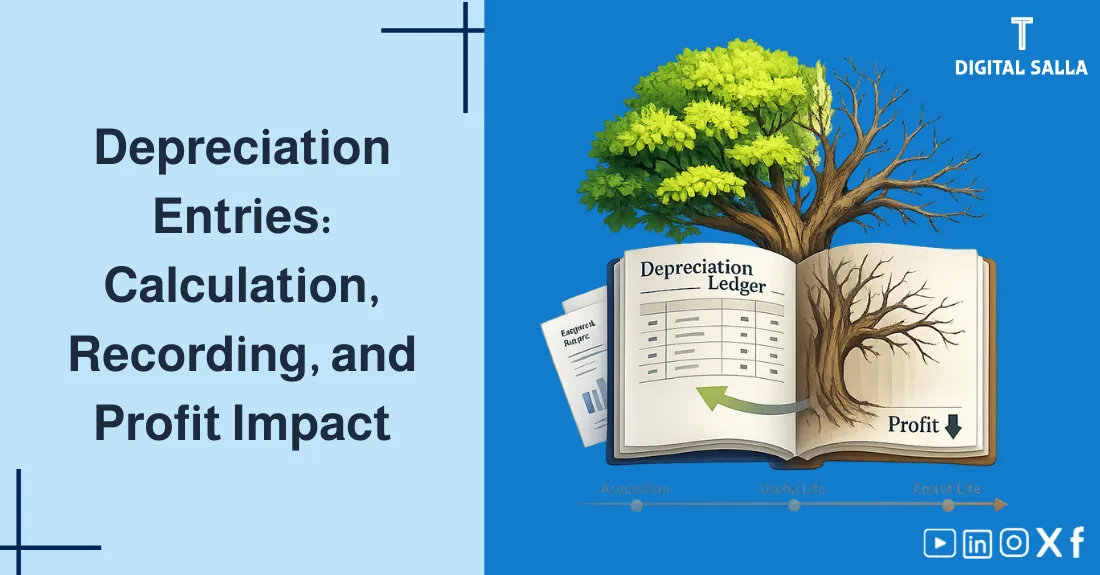
Depreciation Entries: Calculation, Recording, and Impact on Profit
When you buy a machine or a car for your company, its value doesn’t stay “New” forever. Accounting logic requires you to distribute the cost of this asset over the years you use it. This process is called Depreciation. In this guide, we provide a complete explanation of Depreciation Entries: How to calculate them using the Straight-line and Declining balance methods? How to record them in the journal? And why is depreciation considered a “Hidden Guardian” of your company’s real profits?
- Simplified definition: What is Depreciation and why do we record it?
- Detailed comparison between Straight-line and Double Declining Balance methods.
- Visual model (SVG) explaining the impact of depreciation on the Income Statement and Balance Sheet.
- Standard journal entries for recording Depreciation Expense and Accumulated Depreciation.
- Interactive Tool: Calculate your annual depreciation and generate a schedule automatically.
- Common mistakes in asset valuation that lead to distorted profits.
1) What is Depreciation?
Depreciation is the systematic allocation of a fixed asset’s cost over its Useful Life. It is not a measurement of the market value of the asset, but rather a way to match the asset’s cost with the revenue it generates each year (The Matching Principle).
2) Why is Depreciation Important?
- Matching: Distributing the cost fairly over the years of benefit.
- Tax Benefit: Depreciation is a deductible expense that reduces taxable income.
- Asset Replacement: Helping management recognize the need to fund new assets as old ones wear out.
3) Comparison of Calculation Methods
| Method | Logic | Best Suited for… |
|---|---|---|
| Straight-line (SL) | Equal expense every year. | Buildings, Furniture, basic equipment. |
| Declining Balance (DDB) | Higher expense in early years. | Tech (Computers), Vehicles (lose value fast). |
| Units of Production | Based on actual usage (hours/units). | Heavy production machinery. |
4) Visual Logic: Impact on Statements
5) Recording the Journal Entry
Every period (Monthly or Yearly), a standard adjusting entry is made:
Financial Statements Builder - Excel File
Simple Excel Financial Statements Tool helps companies prepare internal financial statements quickly...
6) NBV and Balance Sheet Presentation
On the Balance Sheet, assets are presented at their Net Book Value (NBV):
- Asset Historical Cost: $50,000
- Less: Accumulated Depreciation: ($15,000)
- = Net Book Value (NBV): $35,000
7) Interactive Depreciation Calculator
Calculate your annual depreciation and view the schedule:
8) Common Calculation Mistakes
- Depreciating below Salvage: You must stop depreciating once the Book Value reaches the estimated Salvage (Scrap) value.
- Wrong Method Choice: Using Straight-line for high-tech assets that lose value rapidly can overstate your profits in early years.
- Ignoring Useful Life Updates: If an asset is significantly overhauled, its useful life should be re-evaluated.
9) Frequently Asked Questions
Is depreciation a “Cash” expense?
No. Depreciation is a non-cash expense. No money leaves the bank when you record it. It is purely an accounting adjustment.
When do I stop recording depreciation?
When the asset is fully depreciated (Book Value = Salvage Value) or when the asset is sold or disposed of.
10) Conclusion
The summary is simple: Depreciation is the professional way to recognize that assets wear out. By mastering calculation methods and recording entries correctly, you ensure your financial statements provide a transparent picture of your company’s net worth and prevent the distribution of “Fake Profits” that don’t account for asset consumption.