

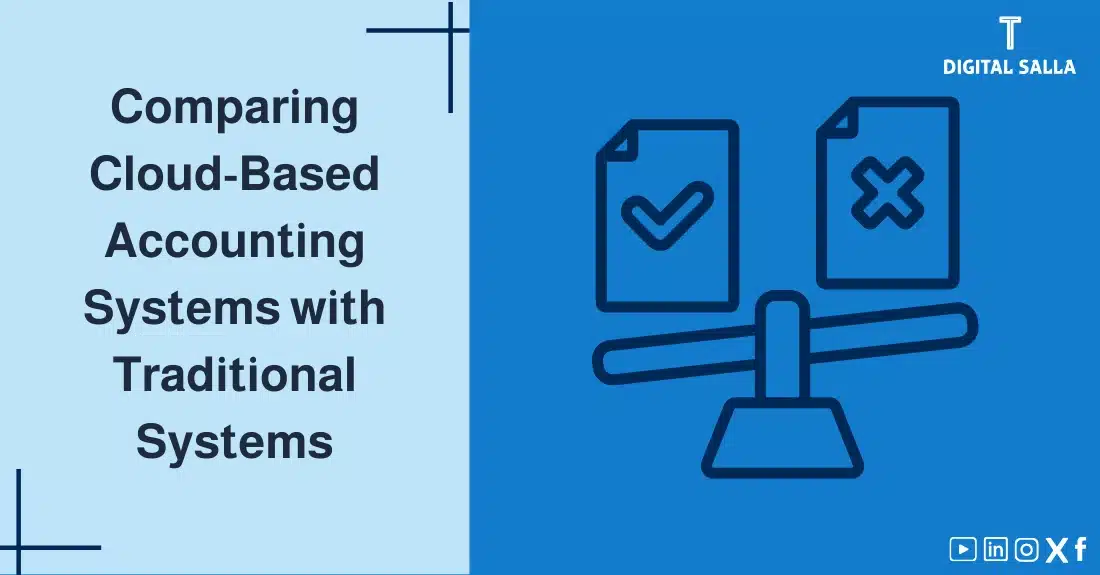
Comparison of Accounting Systems, contrasting cloud-based and traditional options.

Comparing Cloud vs. Traditional Accounting Systems: A Practical Decision Guide (Cost/Security/Control)
This guide explains how to leverage technology and governance to improve operations, enhance data quality, and reduce risks—on Digital Salla. The goal here is not “choosing a trend,” but making a financial and control decision based on Total Cost of Ownership (TCO), security, and operational speed.
- Understanding the real difference between Cloud and On-Premise from an accounting perspective (CapEx/OpEx and TCO).
- A comprehensive comparison table: Cost, Scalability, Security, Compliance, Control, and Customization.
- A quick decision matrix: When to choose Cloud? When to choose On-Premise? And when is Hybrid better?
- A brief migration plan + common mistakes that make projects “stall” or “cost more than expected.”
- A simple calculator to estimate TCO over 3 years (adjustable).
1) Quick Definition: Cloud vs. On-Premise
Before comparing, let’s standardize definitions to avoid confusion:
- Cloud Accounting System: App and data hosted by a provider (or private cloud), usually paid via subscription.
- On-Premise System: Server/database located within your company, with infrastructure and updates managed by your team.
- Hybrid: Part cloud, part local (or cloud archiving with local system) based on compliance or performance needs.
2) Cost Model Difference: CapEx/OpEx and TCO
Many companies say: “Cloud is more expensive” because they only see the monthly subscription, whereas local systems carry “hidden” costs: servers, backups, upgrades, downtime, and IT salaries.
2.1 CapEx vs OpEx (Accounting Logic)
- On-Premise: Tends towards CapEx (Equipment/Licenses) + subsequent maintenance/OpEx.
- Cloud: Tends towards OpEx (Subscription) with limited CapEx for implementation/training.
2.2 What really goes into TCO?
| Item | Cloud | On-Premise |
|---|---|---|
| Implementation & Config | Setup/Permissions/Integrations + Training | Setup + Infrastructure + Training |
| Licenses/Subscription | Monthly/Annual Subscription | Upfront Licenses + Annual Maintenance |
| Infrastructure | Provider’s responsibility (usually) | Server/Storage/Network/UPS |
| Backup & Recovery | Included or paid add-on | Full responsibility (Higher risk if untested) |
| Upgrades & Updates | Usually auto/periodic | Upgrade projects + potential downtime |
| Downtime | Calculated per SLA | Calculated by team readiness & infra |
3) Comprehensive Comparison Table (Cost/Security/Control/Speed)
This is a practical “decision table.” Read the rows that matter to your company size, sector, and compliance requirements.
| Axis | Cloud | On-Premise |
|---|---|---|
| Go-Live Time | Faster start usually | Slower due to infra setup |
| Flexibility & Scale | Elastic (Add users/branches easily) | May require server/storage expansion |
| Cost Structure | Recurring Subscription + Impl. Cost | Upfront Investment + Maint + IT |
| Security | Strong if permissions managed well (Shared Resp.) | Higher control but higher security burden on you |
| Data Control | Depends on contract/residency/export | Direct control inside company |
| Customization | Moderate (Config/API/Add-ons) | Deep customization possible but costly to maintain |
| Integration | Often easier with SaaS tools | Possible but needs infra & internal linking |
| Audit Readiness | Good if Audit Trail & Reports exist | Good if internal logs/docs are strong |
4) Security & Compliance: Where are the risks?
Biggest misconception: “Cloud is insecure.” Reality: Many cloud breaches are due to excessive permissions/wrong sharing settings/ungoverned integrations—not weak infrastructure.
4.1 Shared Responsibility Model
- Provider secures infrastructure (Data Center/Network).
- You secure Users, Permissions, Data, and Export policies.
4.2 Compliance Points before Signing
- Data Residency: Where is it stored? Can you choose the region?
- Audit Logs: Exportable? Retention period?
- Exit Strategy: Full data export? Secure deletion? Grace period?
5) Operations & Updates: Who pays for “Downtime”?
Accounting hates surprises: System downtime on closing day or payroll time creates indirect losses. Compare:
- Upgrades: On-Prem upgrades are projects (time + downtime + testing). Cloud is continuous updates.
- Backup: On-Prem is your full responsibility. Cloud is usually included (verify SLA).
- Support: On-Prem needs a strong local team/vendor, otherwise you pay “downtime” instead of “subscription.”
6) Integration, Customization & Data
The choice stops at the ecosystem: Sales, Purchasing, Inventory, Payroll, Banks. Ask: Do you want Accounting Software only or a full ERP?
6.1 Integration Costs
- Cloud: Faster integration with SaaS, but watch API limits.
- On-Prem: Possible but requires network/security setup and maintenance.
6.2 Customization: A “Feature” that becomes a Cost
Deep customization in On-Prem looks tempting but creates “Technical Debt” during upgrades. Cloud relies on Configuration/Workflow—less flexible sometimes but sustainable.
7) Decision Matrix: When to choose Cloud, On-Prem, or Hybrid?
| Scenario | Best Fit | Why? |
|---|---|---|
| Startup/SME wanting speed & scale | Cloud | Lower infra burden + Fast Go-Live + Pay-as-you-go |
| Strict regulatory/data residency needs | On-Prem / Private Cloud | Higher control over location & access |
| Multi-branch + Remote teams | Cloud | Easier access + Central management |
| Need legacy system + cloud analytics | Hybrid | Balance compliance with flexibility |
8) Implementation Plan & Common Mistakes
8.1 4-Step Plan (Concise)
- Define Requirements: Modules? Users? Critical Reports?
- Design Controls: Permissions, SoD, Audit Trail, Export Policy.
- Pilot: Run on one dept/branch + Measure.
- Go-Live + Monitor: Exception reports weekly for 8 weeks.
8.2 Costly Mistakes
- Ignoring Migration/Training Costs: Leads to “surprise invoices.”
- Excessive Permissions: Leads to fraud risks.
- Dirty Data: Migrating duplicates ruins first close.
9) TCO Calculator (3 Years)
This calculator is estimative to visualize the picture. Adjust numbers to your reality.
10) FAQ
Is Cloud only for small businesses?
No. Cloud is great for multi-branch or fast-scaling companies—provided permissions and governance are managed. Large enterprises use Cloud or Hybrid depending on compliance.
When is On-Premise a stronger choice?
When compliance/data residency needs are strict, deep customization is required, or you have strong infrastructure and a mature ops team.
What is the biggest Cloud risk practically?
Excessive permissions and uncontrolled data sharing/export.
11) Conclusion & Checklist
The Cloud vs On-Prem decision isn’t just tech—it’s Cost + Risk + Ops + Audit. Use TCO over 3 years, then test via Pilot and clear KPIs.
- Define requirements (Modules/Branches/Users).
- Compare 3-Year TCO (Sub/License/IT/Updates).
- Design Controls: Permissions + SoD + Audit Trail.
- Check Compliance: Data location, Logs, Exit plan.
- Plan Migration: Clean data + Test samples.
- Execute Pilot then gradual Go-Live.